

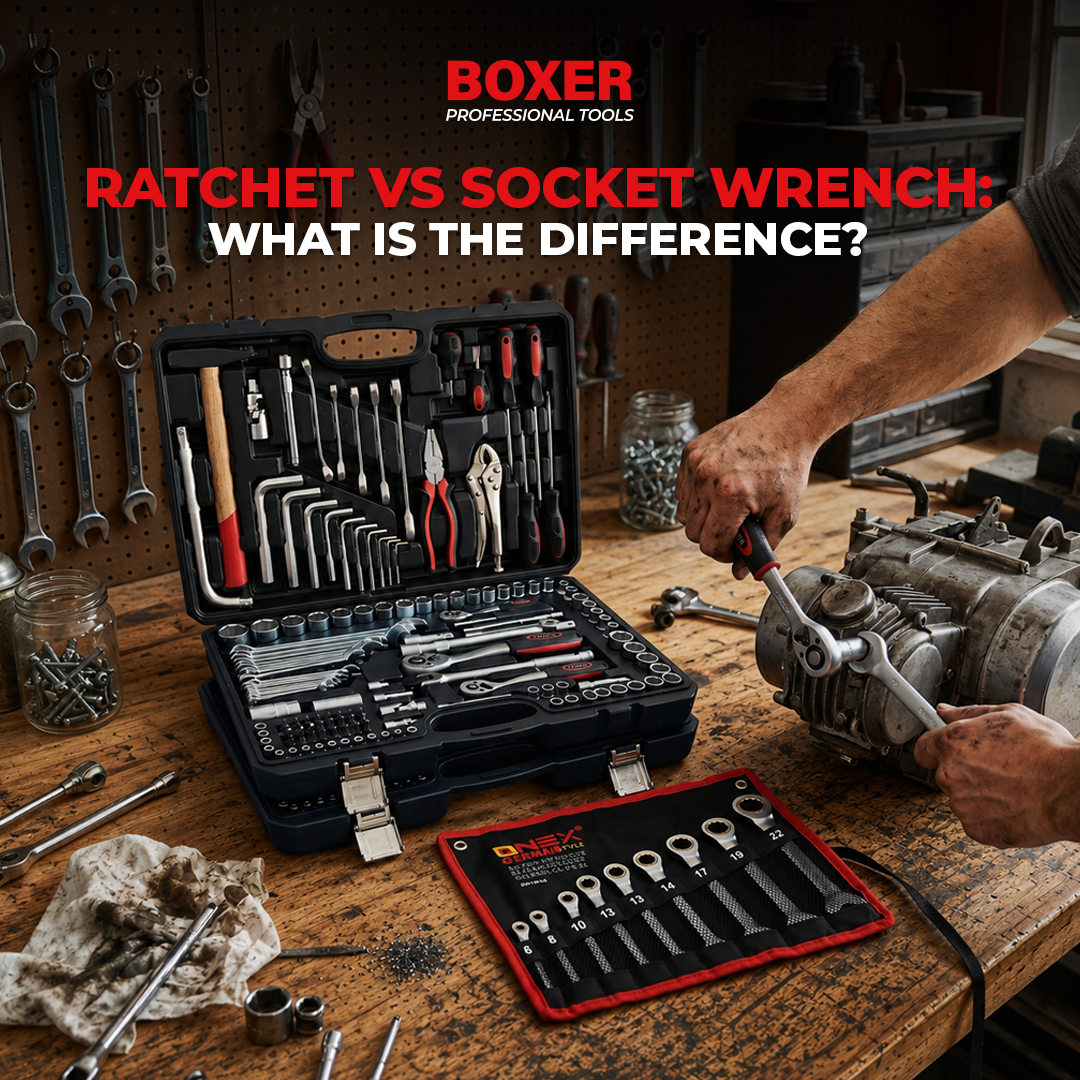
Ratchet vs Socket Wrench: What Is the Difference?
Understanding the difference between a ratchet and a socket wrench helps mechanics, workshop owners, and DIY users improve speed, safety, and efficiency during repair work.
At Boxer Professional Tools, a trusted power tool manufacturer and wholesale supplier across Europe, we provide premium ratchets, socket wrenches, and durable hand tools built for strength and long-lasting performance. This guide explains the key differences between a ratchet vs socket wrench and helps you choose the right tool for your needs.
What Is a Ratchet?
A ratchet is a hand tool that uses a ratcheting mechanism to tighten or loosen fasteners without removing the tool from the bolt after every turn. It uses a ratcheting mechanism that moves in one direction while resetting in the other. This design allows users to work faster, especially in tight spaces where movement is limited.
How the Ratcheting Mechanism Works
The ratchet wrench operates through an internal gear-and-pawl mechanism located inside the ratchet head.
When the handle moves in one direction:
- The gear engages and rotates the fastener
- The socket turns the bolt or nut
- Force is transferred smoothly to the fastener
When the handle moves back:
- The pawl slips over the gear teeth
- The fastener does not move
- The user can continue working without repositioning the tool
This continuous motion is what makes a ratchet wrench faster and more convenient than many traditional hand tools. Most modern ratchets also include a directional switch, allowing users to quickly alternate between tightening and loosening.
Common Uses of a Ratchet
Ratchets are commonly used for:
- Automotive repair tools
- Engine maintenance
- Brake servicing
- Garage repairs
- Mechanical workshop tasks
Advantages of Using a Ratchet
Ratchets offer several practical benefits for both professionals and DIY users.
- Faster Operation: The ratcheting action speeds up repetitive fastening tasks.
- Better Access in Tight Spaces: Because the tool requires less movement, it works well in confined areas.
- Reduced User Fatigue: Continuous motion minimizes repetitive repositioning and reduces strain.
- Improved Efficiency: Mechanics and technicians can complete jobs faster and with greater precision.
At Boxer Professional Tools, our ratchet systems are engineered with ergonomic grips, smooth mechanisms, and professional-grade construction to deliver reliable performance in demanding environments.
What Is a Socket Wrench?
A socket wrench is a fastening tool designed to work with interchangeable sockets for tightening or loosening nuts and bolts. Unlike fixed-size wrenches, socket wrenches allow users to switch socket sizes depending on the fastener. The term “socket wrench” is broader than “ratchet” because it includes multiple socket-driving tools.
Structure of a Socket Wrench
A socket wrench system typically includes:
- A drive handle
- Interchangeable sockets
- Extensions
- Adapters
- Specialized attachments
Different types of socket wrenches include:
- Ratchet wrenches
- Breaker bars
- Torque wrenches
- Speed handles
- T-handle socket drivers
A ratchet is technically one type of socket wrench, but not every socket wrench includes a ratcheting mechanism.
How Socket Wrenches Work
The user selects the appropriate socket size and attaches it to the drive tool.
Once connected:
- The socket fits securely around the fastener
- Rotational force is applied through the handle
- The bolt or nut is tightened or loosened
This system allows one tool setup to handle many fastener sizes efficiently.
Common Uses of Socket Wrenches
Socket wrenches are widely used in:
- Automotive workshops
- Industrial maintenance
- Construction projects
- Mechanical assembly
- Manufacturing facilities
- Home repairs
Their versatility makes them one of the most important mechanic tools for professionals and DIY users.
Ratchet vs Socket Wrench: Key Differences
Although these tools work together, they have several important differences.
Functionality
- A ratchet focuses on speed and convenience.
- A socket wrench system provides broader fastening solutions.
Design
- Ratchets use a gear-and-pawl mechanism.
- Socket wrench systems include different handles and accessories.
Flexibility
- Socket wrench systems offer more versatility with multiple tool options, while ratchets are better for confined spaces.
Speed and Convenience
- Ratchets are faster for repetitive fastening because they reduce repositioning.
Precision and Control
- Torque wrenches within a socket wrench system provide greater torque accuracy for precision applications.
Ease of Use
- Ratchets are easier for beginners because they simplify repetitive movement.
Applications
Ratchet
- Tight spaces
- Automotive repair
- Repetitive fastening
- Workshop maintenance
Socket Wrench
- Heavy-duty fastening
- High-torque applications
- Industrial repair
- Precision tightening
Professional and DIY Usage
Professionals generally require:
- Heavy-duty construction
- Long-term durability
- Precision engineering
- Ergonomic performance
Boxer Professional Tools provides solutions suitable for both professional workshops and home users looking for reliable mechanic tools.
When Should You Use a Ratchet?
A ratchet wrench is best for:
- Tight working spaces
- Fast repetitive tasks
- Automotive repair jobs
- Garage maintenance
Its compact movement helps mechanics work efficiently in limited spaces like engine bays and machinery compartments.
When Should You Use a Socket Wrench?
Socket wrenches are ideal for:
- Heavy-duty fastening
- High-torque applications
- Industrial maintenance
- Precision work
Breaker bars and torque wrenches provide better leverage and control for demanding jobs.
Choosing the Right Tool for Your Work
Choosing between a ratchet and a socket wrench depends on your project needs.
Consider These Factors:
- Project type
- Torque requirements
- Durability
- Grip comfort
- Socket compatibility
- Frequency of use
Professionals often choose Boxer Professional Tools because of their ergonomic design, durable construction, and reliable performance.
Maintenance and Care Tips
Proper maintenance helps extend the lifespan of your ratchets and socket wrenches.
- Best Maintenance Practices
- Clean tools after use
- Store tools in dry conditions
- Lubricate ratchet mechanisms regularly
- Prevent rust and moisture exposure
- Inspect moving parts for wear
Routine care improves tool performance and long-term reliability.
Why Professionals Choose Boxer Tools
Choosing between a ratchet and a socket wrench depends on your work requirements, torque needs, and working environment. While ratchets offer speed and convenience for tight spaces, socket wrench systems provide flexibility and better control for demanding fastening tasks.
Investing in durable and professional-quality mechanic tools improves productivity, precision, and long-term reliability. Boxer Tools delivers high-performance ratchets, socket wrenches, and durable hand tools trusted by workshops, mechanics, and industrial professionals across Europe.
Related Blogs
Who Buys Angle Grinders and Electric Drills? A Guide for Wholesale Tool Suppliers
Why the 185mm Circular Saw Is the Best Seller Every Tool Shop Should Stock
Boxer SR040 24V Cordless Drill Set: The All-in-One Kit for DIY Users & Wholesale Buyers
Cordless Drills Wholesale Europe 2026: Best Picks for Projects and Professional Use
Hand Tools Wholesale for Europe: Your Autumn and Winter Stocking Guide
Cordless Power Tools Wholesale 2027: Why Cordless Drills Will Be the Top-Selling Tool This Season
How to Choose a Heavy-Duty Concrete Drill Machine: A Buyer's Guide by Boxer Tools

SIGN UP FOR NEWSLETTER
Copyright © 2026 Boxertools | Developed By Mammar Tech