

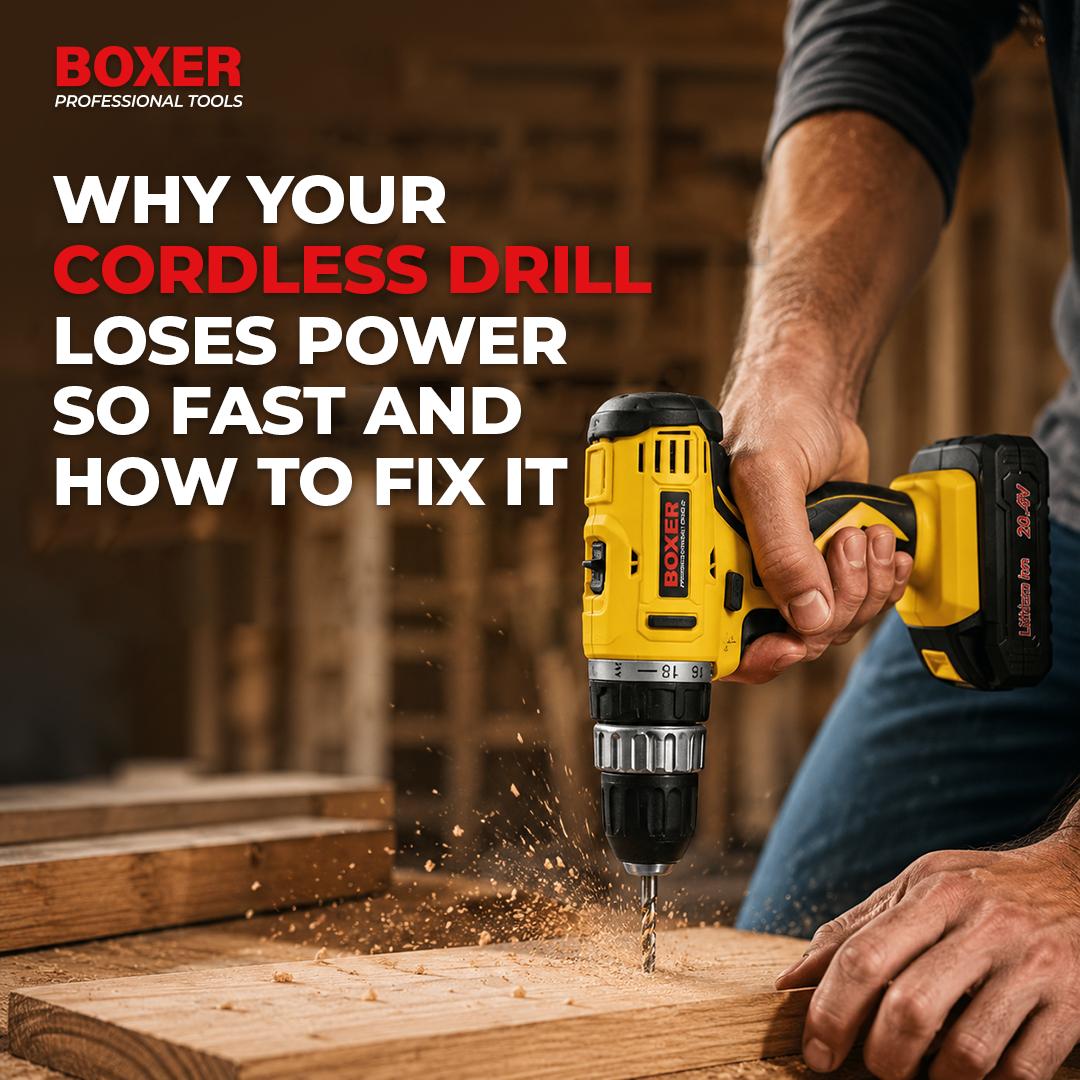
Why Your Cordless Drill Loses Power So Fast — And How to Fix It
You're halfway through a job. The drill felt fine ten minutes ago. Now it's sluggish, struggling, and you're watching the battery indicator drop faster than it should.
Sound familiar?
This is one of the most common complaints we hear at Boxer — and nine times out of ten, the drill itself is absolutely fine. The problem is somewhere else entirely, and it's almost always fixable without spending a penny on a new tool.
Here are the six real reasons your cordless drill is draining fast, and exactly what to do about each one.
1. You're Running It on the Wrong Speed
Most people leave their drill on high speed and forget gear 1 exists. That's a mistake.
High speed is only for drilling soft wood. For screws, dense timber, and harder materials, gear 1 (low speed, high torque) cuts battery consumption by up to 40% per charge.
The fix: Gear 1 for screws and hard materials. Gear 2 for drilling only. Get into the habit, and your batteries will last noticeably longer.
2. Your Battery Has Been Stored Wrong
Lithium-ion batteries have two real weaknesses: heat and deep discharge.
A battery left completely flat for a month can permanently lose 20–30% of its capacity. Storing in a hot car, near a boiler, or in direct sunlight does the same damage — just more slowly.
The fix: Store at 40–60% charge in a cool, dry place. If it's sitting unused for more than two weeks, charge it to half first. Never leave a flat battery overnight — charge it the same day.
3. The Battery Is Just Old
This one is easy to miss because the battery usually looks completely fine on the outside.
Li-ion batteries have a lifespan of roughly 300 to 500 full charge cycles. After that, they start losing capacity — not all at once, but gradually. A battery that's been used hard on a building site for two years might only hold 60% of what it did when it was new.
How to tell if this is your problem
Think back. Did the drill used to run for 45 minutes on a full charge, and now it drops out after 20? Have you been using it most days for 18 months or more? If yes, the battery is almost certainly the issue — not the drill.
The fix: Replace the battery pack. A fresh battery can make an old drill feel brand new. Match the voltage (18V or 20V) and go for at least the same Ah rating — or higher. A 4.0Ah battery will give you significantly longer runtime than a 2.0Ah.
- Need a replacement? The Boxer BX140 comes with two 2.2Ah Li-ion batteries and a 1-hour fast charger — good value if your whole setup is ageing.
4. The Bit Is Blunt (or the Wrong One Entirely)
A sharp, correctly matched drill bit barely notices the material it's going through. A blunt or wrong bit fights it — and that fight uses your battery.
A dull masonry bit on a concrete wall can draw three times the current of a sharp one doing the same job. That's the difference between 40 minutes of runtime and 13.
Signs the bit is your problem
The drill vibrates more than it used to
You're pressing harder to make progress
The bit gets warm or hot during use
The fix: Replace bits more often than you think you need to. A rough guide: if a bit has drilled more than 100 holes in hard material, swap it out. And always use the right bit for the material — HSS for metal, wood bits for timber, masonry or SDS for concrete and brick.
5. The Motor Is Overheating (This One Gets Misdiagnosed a Lot)
Here's something most people don't realise: when a cordless drill motor gets too hot, the thermal protection circuit deliberately cuts power to protect it. It feels exactly like a dying battery — but it isn't.
This usually happens when the drill is used non-stop for more than 10–15 minutes, when the bit keeps stalling against hard material, or when the ventilation slots on the body are clogged with dust and debris.
The fix: Work in 10–12-minute cycles with a short break in between for heavy tasks. Clear the ventilation slots regularly with compressed air or a soft brush — it takes 30 seconds and makes a real difference. And if the drill stalls, ease off the pressure instead of pushing harder.
6. You're Not Rotating Your Batteries Evenly
If you work with two or three battery packs, it's easy to always reach for the same one — especially if it's the one you just charged. But this creates two problems at once.
The battery you always use gets overworked. The ones that sit fully charged on the shelf for days or weeks slowly lose capacity from the other end. You're degrading all of them, just in different ways.
The fix: Label your battery packs (1, 2, 3) and rotate them. Use pack 1 today, pack 2 tomorrow. If you're done for the day and the batteries are full, let them run down slightly on the next job before storing — don't leave them at 100% for extended periods.
Still Draining Fast? It Might Be the Drill Itself
If you've worked through all six of the above and nothing's changed, the problem may be inside the drill — worn carbon brushes on a brushed motor, a failing motor winding, or a damaged charge port. These are worth having looked at by a repair technician rather than assuming a new battery will fix it.
Upgrade to a Boxer Cordless Drill
If your drill is at the end of its life and it's time to start fresh, Boxer's cordless drill range is built for both professional site use and everyday home jobs.
Need larger quantities or wholesale pricing? Get in touch directly:
Quick Summary
| Problem | Fix |
|---|---|
| Wrong speed setting | Gear 1 for screws and hard materials |
| Poor battery storage | Store at 40–60% charge, cool and dry |
| Degraded battery | Replace — match voltage, go higher Ah |
| Blunt or wrong bit | Swap regularly, match bit to material |
| Motor overheating | Work in cycles, clear ventilation slots |
| Uneven battery rotation | Label packs and rotate daily |
Related Blogs
How to Choose a Heavy-Duty Concrete Drill Machine: A Buyer's Guide by Boxer Tools
How Does an Air Blower Work? A Practical Guide to the Mechanics and Uses
Power Tool Trends for 2026: A Guide for Wholesale Buyers and Distributors
Top 10 Wholesale Angle Grinder Manufacturers Worldwide
How to Choose the Right Cordless Garden Tools in 2026
How to Start a Power Tool Distribution Business in Europe: The Complete 2026 Guide

European Power Tools Suppliers: How to Find the Best Wholesale Partners in 2026

SIGN UP FOR NEWSLETTER
Copyright © 2026 Boxertools | Developed By Mammar Tech